
Capital Gains Tax (CGT) is a frequent target for Chancellors looking to boost Treasury revenues ahead of a Budget. Over the last few years, the threat of tax hikes has firmly materialised into significant policy shifts that directly impact investors and their wealth.
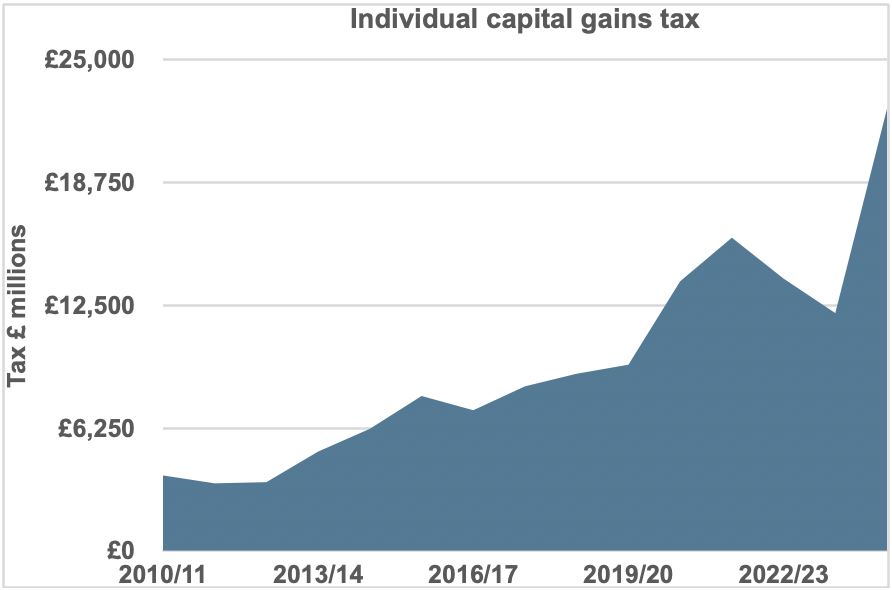
(Source: HMRC)
Recent Changes to Capital Gains Tax
In recent tax years, investors have faced a two-pronged approach to tightening CGT rules, resulting in a sharp rise in tax liabilities.
Shrinking Annual Exemptions
The annual exemption—the amount of net profit you can realise in a tax year completely free of CGT—has been drastically reduced. It was slashed from £12,300 in 2022/23 down to £6,000 for 2023/24, and cut again to just £3,000 for 2024/25, where it currently remains frozen.
Rising Tax Rates
Alongside shrinking allowances, the main rates of tax were officially increased in the Autumn Budget 2024. Rates rose from 10% to 18% for basic rate taxpayers, and from 20% to 24% for higher and additional rate taxpayers.
The ‘Behavioural Response’ to Budget Fears
These policy changes have dramatically increased the tax burden. New figures released by HMRC in August 2026 showed that individuals generated an astonishing £22.5bn in CGT revenue during 2024/25—an 86% leap compared to 2023/24.
However, this massive spike in tax receipts is largely driven by a ‘behavioural response’ rather than organic growth. Following Keir Starmer’s general election victory in July 2024, Chancellor Rachel Reeves announced a £22 billion economic ‘black hole’. Fearing harsh tax rises in the subsequent Autumn Budget 2024, many investors chose to preemptively take profits and trigger tax liabilities at the lower rates, artificially boosting the CGT revenue figure for that year.
Who is Actually Paying the Bill?
While the total revenue is vast, this behavioral response came from a relatively concentrated group of investors. In 2024/25, just over 550,000 people faced a CGT bill, equating to roughly one in 70 income taxpayers.
Even within this group, the numbers are heavily skewed. Nearly 33,000 people accounted for over three-quarters of the £22.5bn total. At the very top end of the spectrum, 3,000 taxpayers realised gains of at least £5 million, paying an average of £3.3 million each in capital gains tax.
Protecting Your Wealth for the Future
It is incredibly easy to dismiss CGT as somebody else’s problem or a “wealth tax” that won’t affect you. However, with the annual exemption now sitting at a lowly £3,000, many everyday investors are likely to discover just how easily they can trigger a tax bill.
This environment provides yet another compelling reason to proactively manage your wealth and maximise your contributions to tax-efficient wrappers, such as CGT-free Individual Savings Accounts (ISAs).
Speak to Chartwell Wealth Management
Are you concerned about how these Capital Gains Tax rules affect your portfolio? At Chartwell Wealth Management, our expert advisers are here to help you navigate the changing tax landscape. We can review your financial circumstances, structure your investments efficiently, and ensure you aren’t paying more tax than necessary. Get in touch with Chartwell Wealth Management today to secure your financial future.
Important Information: Investing in shares should be regarded as a long-term investment and should fit in with your overall attitude to risk and financial circumstances. The value of investments and the income from them can fall as well as rise and investors may not get back what they originally invested, even taking into account the tax benefits. Investors do not pay any personal tax on income or gains, but ISAs may pay unrecoverable tax on income from stocks and shares received by the ISA managers. Stocks and Shares ISAs invest in corporate bonds, stocks and shares and other assets that fluctuate in value. Tax treatment varies according to individual circumstances and is subject to change. The Financial Conduct Authority does not regulate tax advice.