

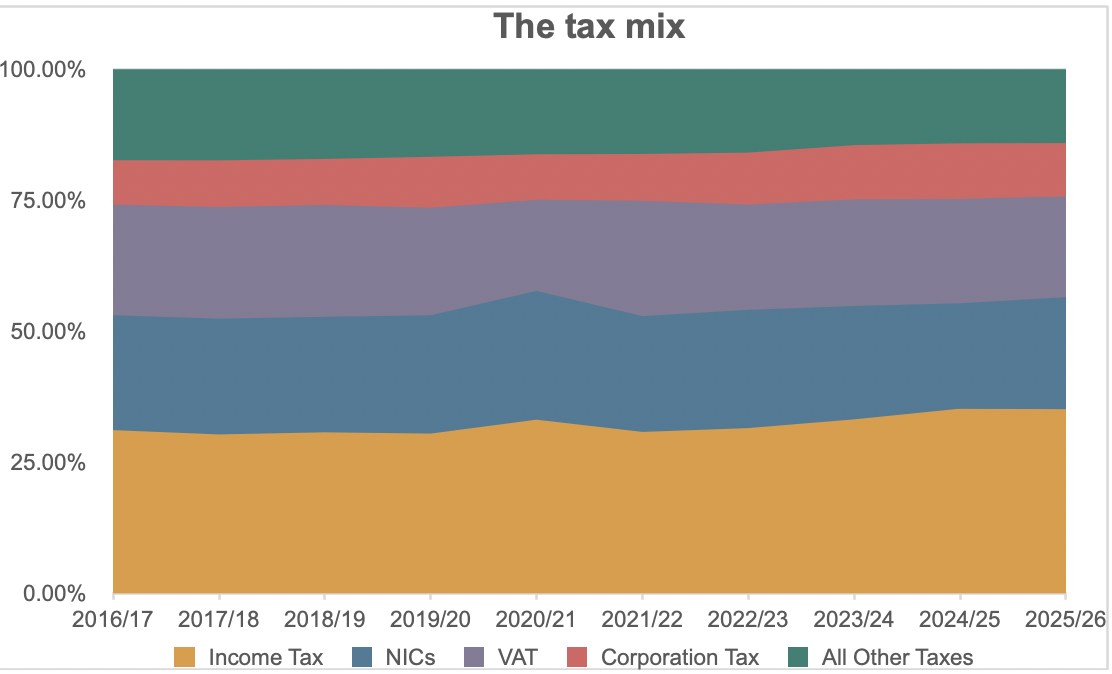
New data from HMRC highlights just how heavily the UK government relies on a tiny blend of revenue streams, pulling the vast majority of its funding from a very small “cocktail” of core taxes.
The Quadruple Tax Lock
The Labour Party went into the 2024 general election with pledges on four major taxes in its manifesto:
“Labour will not increase taxes on working people, which is why we will not increase National Insurance, the basic, higher, or additional rates of Income Tax, or VAT.”
“Labour will cap corporation tax at the current level of 25 per cent, the lowest in the G7, for the entire parliament…”
At the time, these tax promises were seen as politically necessary to counter suggestions that a Keir Starmer government would operate tax-and-spend policies. However, the quadruple tax lock was widely criticised by many economists for the half-decade constraint it placed on the Chancellor during uncertain economic times.
Vindicated Economists: The Big Four Take Center Stage
Fast forward about two years from the publication of that manifesto, and those economists have been completely vindicated. New data from HMRC, published at the end of April, showed that in the past tax year, Income Tax, National Insurance (NI), VAT, and Corporation Tax accounted for 86% of all tax receipts.
This concentration is part of a long-term trend; over the past ten years, this specific quartet has consistently accounted for more than £4 out of every £5 collected by the state.
Fiscal Drag Drives Income Tax Growth
Despite the explicit manifesto promises, income tax receipts rose by 9% in 2025/26 compared to the previous year—rising significantly faster than the growth in prices or the wider UK economy.
This outpacing is primarily driven by “fiscal drag”—the freezing of the personal allowance and tax thresholds. As inflation and wages rise, these frozen boundaries drag more lower earners into the tax system and push existing taxpayers into higher brackets.
Employer Contributions Push NI Receipts Higher
National Insurance receipts grew at an even faster rate, climbing 16.3% higher. This sharp spike was fuelled by manifesto-challenging changes made to the level of employer’s NI contributions. Together, NI and income tax—the state’s two primary taxes on earnings—accounted for a massive 56.5% of everything flowing into HMRC’s coffers.
| Tax Type | Revenue Growth (2025/26) | Share of Total HMRC Receipts |
| National Insurance (NI) | +16.3% | Combined with Income Tax: 56.5% |
| Income Tax | +9.0% | |
| VAT | +5.7% | Third largest individual source |
| Corporation Tax | +4.6% | Slowed by employer NI reliefs |
The jumps in earnings-based taxes stood in stark contrast to the growth seen in the third largest revenue source, VAT, which grew by 5.7%. Corporation tax saw even slower growth at 4.6%, likely because businesses claimed higher tax relief on those increased employer NI contributions.
Preparing for the Next Budget
The overwhelming dominance of these four manifesto-locked taxes explains why the Chancellor has resorted to making so many structural tweaks to the wider system to raise additional revenue. Be prepared: with the core “cocktail” locked down, it is beginning to look highly likely that this process of complex micro-tweaking will be repeated at the next Budget.
Important Legal Disclaimers
-
Tax treatment varies according to individual circumstances and is subject to change.
-
The Financial Conduct Authority does not regulate tax advice.
Navigating the Shifting Tax Landscape with Chartwell Wealth Management
As the government continues to adjust the finer gears of the UK tax system to generate revenue, proactive financial planning has never been more vital. Leaving your wealth exposed to frozen thresholds and changing allowances can quietly erode your hard-earned financial security.
At Chartwell Wealth Management, we help you look at the bigger picture. Our team specialises in structuring your investments, pensions, and allowances to ensure your financial strategy remains robust, tax-efficient, and fully aligned with your long-term goals.
Don’t let fiscal drag compromise your future. Contact Chartwell Wealth Management today to book a comprehensive financial review.