The gender pay gap does not disappear when work ends. If anything, it gets significantly worse.
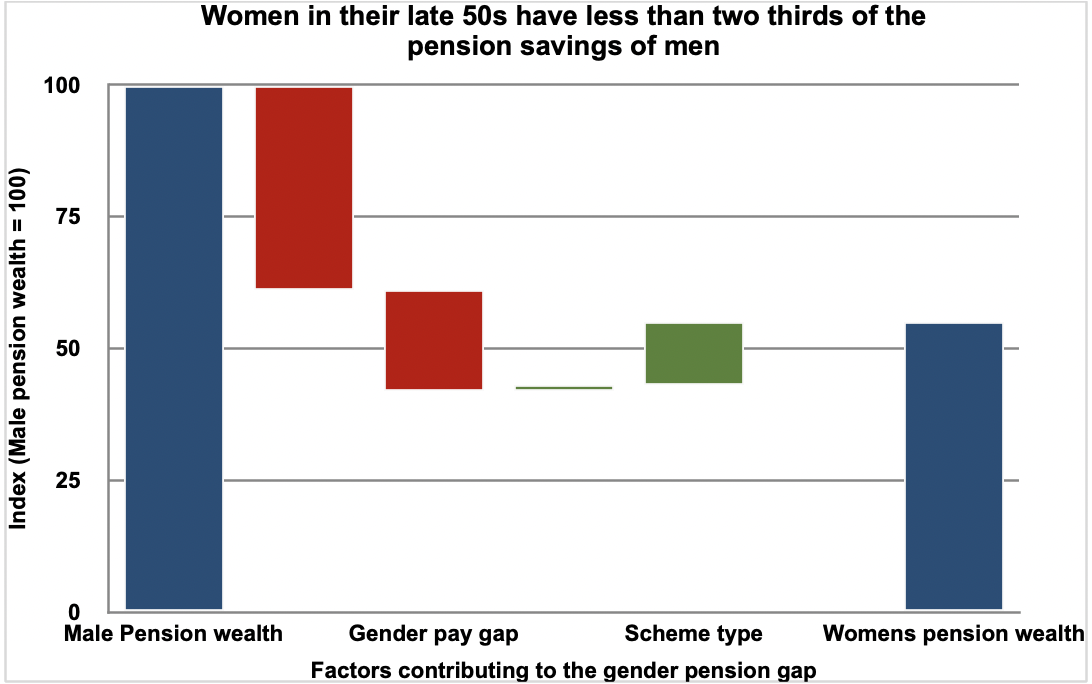
(Source: PPI)
How Wide is the Traditional Gender Pay Gap?
The answer might surprise you. The most recent assessment from the Office for National Statistics (ONS) puts the gender pay gap for full-time employees in April 2025 at 6.9%. While there is still work to do, this represents progress; in 2005, the ONS figure was nearly twice as much, sitting at 13%.
However, there is another, far less discussed gap where the difference between the sexes is dramatically greater: the gender pension gap.
The Reality of the Gender Pension Gap
A new report from the Pension Policy Institute (PPI) has highlighted this divide. Calling it a “gap” might be an understatement; a “chasm” is a much more accurate description of the disparity in pension wealth between men and women in their late 50s, a demographic typically within ten years of retirement.
Based on data for men and women aged 57, the PPI graph reveals a staggering 46% gap. Viewed from the male perspective, this means that, on average, a 57-year-old man holds 85% more in his pension pot than a woman of the exact same age.
What is Driving the Pension Inequality?
The PPI attributes this yawning gap to a variety of systemic factors, with the two primary drivers being differing working patterns and the compounding effect of the traditional pay gap.
Differing Working Patterns
The proportion of women in employment is lower than for men (75% versus 82%). Crucially, among those who are in employment, significantly more women tend to work part-time (33% versus just 10% of men), often because they serve as a family’s primary caregiver.
Interestingly, the gender pay gap for part-time work actually favours women, with the ONS noting that female part-timers earn 2.9% more per hour than their male counterparts. The snag, however, is that while the hourly pay rate may be marginally higher, total overall earnings are drastically lower than those generated by full-time work.
The Compounding Effect of the Pay Gap
Pension contributions are normally linked directly to pay, typically calculated as a percentage of your salary. Because women, on the whole, earn less than men, applying the same percentage contribution produces a much smaller cash contribution each month, eventually resulting in a substantially smaller pension pot.
At lower earnings levels, this disparity is severely exacerbated by automatic enrolment rules. The current rules completely exclude anyone earning up to £10,000 a year. Furthermore, for those who are enrolled, the rules ignore the first £6,240 of earnings when calculating contributions. In practical terms, this equates to roughly £500 a year of contributions (at an 8% rate) that are simply never made. Over a working lifetime, missing out on this compounding growth is devastating to final retirement figures.
Speak to Chartwell Wealth Management
If you find yourself on the wrong side of the pension gender gap, it is crucial to take proactive steps now to secure your future. Consider increasing your personal pension contributions if possible, and seek professional advice on your overall retirement planning strategy.